Too much manual work for a small team
The report your team assembles every Monday can build itself
Maestra Platform generates it from live data, the all-in-one retention marketing platform for ecommerce brands, set up by a forward-deployed marketer.
Brands running on Maestra






The problem
Merchandising and personalization shouldn't be a manual job
Picking products for every recommendation slot by hand doesn't scale past a handful of pages. Teams end up leaving most of their catalog without proper recommendations simply because there isn't time to curate it all.
What we hear from brands
a handbag brand: a small ecommerce team manually manages merchandising and A/B tests, limiting scale
a four-person accessories brand: struggling to manually choose products for campaigns and research bestsellers
a city sports-merch retailer: a clunky, manual product-to-campaign workflow, a small team stretched thin
The new way
Dynamic content replaces manual updates
Instead of editing every email and SMS by hand each time a promotion changes, dynamic content updates banners and text automatically, on schedule, across every flow. I Love Linen freed up 5 hours a week this way, enough to preschedule an entire holiday period in advance.
Customer proof
Nobody had time to test the mobile popup. So it stayed broken.

A capture rate of a quarter of a percent had gone unexamined because examining it was a project. A structured test framework tripled it without adding anyone to the team.
0.26% → 0.8%
the mobile pop-up's lead capture rate

How it works
Access, approvals, and not much else from you
Hand over the keys
Read access to the tools you run today is enough for your marketer to see what has to move.
Answer a few questions
A handful of decisions only you can make, and help with warming the sending domains, is the whole of your involvement.
Approve and go
Everything else is built, tested, and launched for you, which is why brands describe the switch as the smoothest one they have run.
The platform
Why the data model is the product
Most platforms bolt commerce concepts onto a generic contacts table. Maestra starts from orders, catalog, and behavior, which is why segmentation, recommendations, and site personalization read the same customer rather than three approximations of one.
Including
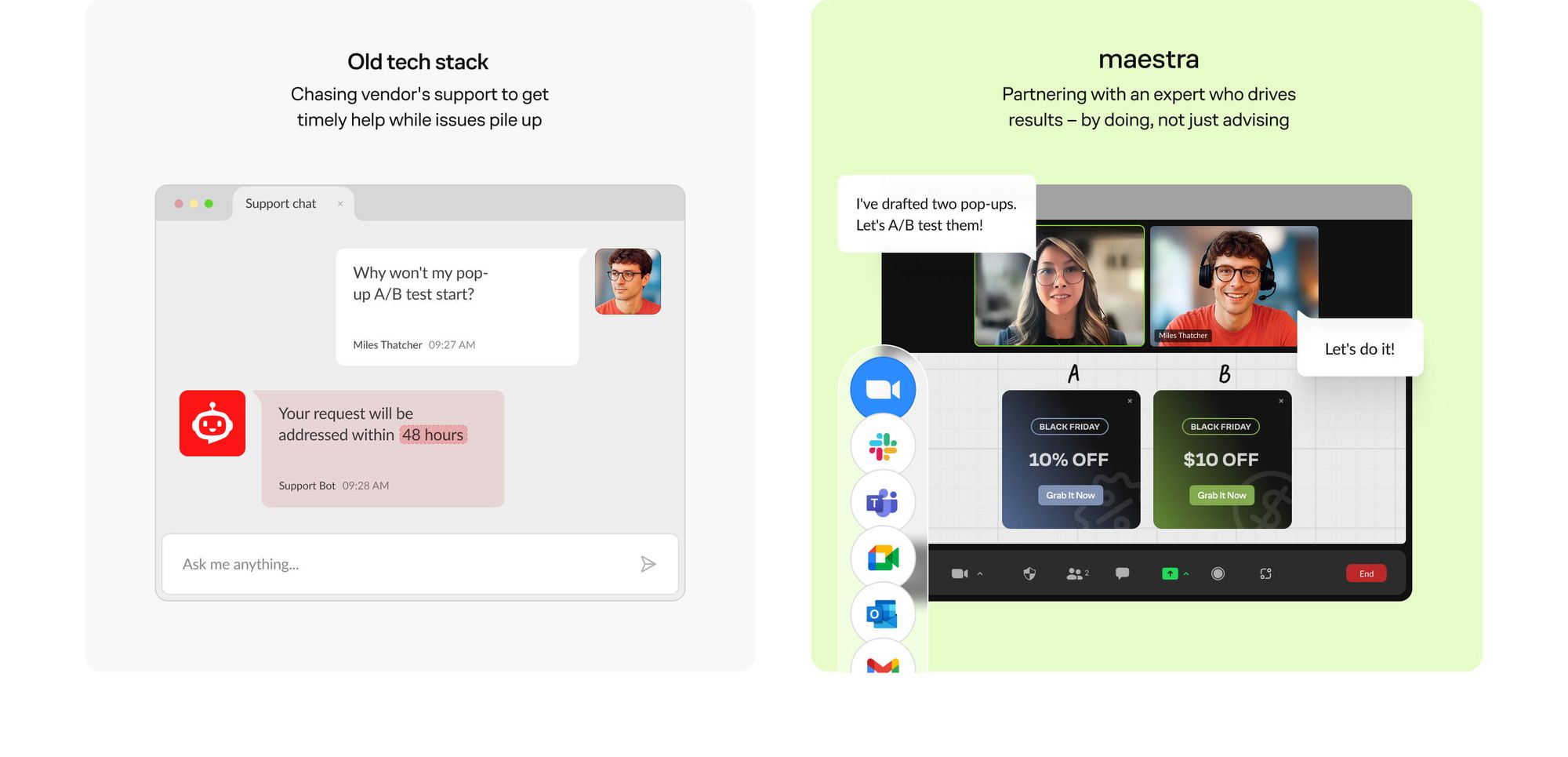
Your forward-deployed marketer
The difference between advice and implementation
An agency sends recommendations and an invoice. Your marketer opens the platform and builds the thing, which is why the improvements that are technically easy but always postponed actually ship.
Work delivered in the platform, not as a deck
The postponed improvements get shipped
No separate services fee
Replace your stack
Brands usually replace three to five tools
Email and SMS, lead capture, recommendations, loyalty, and whatever glue holds them together. Each of them works better once it reads the same profile as the rest.
Replaces
Klaviyo
Rebuy
Yotpo
Wisepops
Zapier
Worth a look if any of this sounded familiar
The product pages show what the platform does with the data once it is in one place.